Nikon defends AI winner as scientists question cilia video
Researchers say structures in Dr. Ning Xu's first-place clip are biologically impossible, but Nikon says no rules were violated so far.
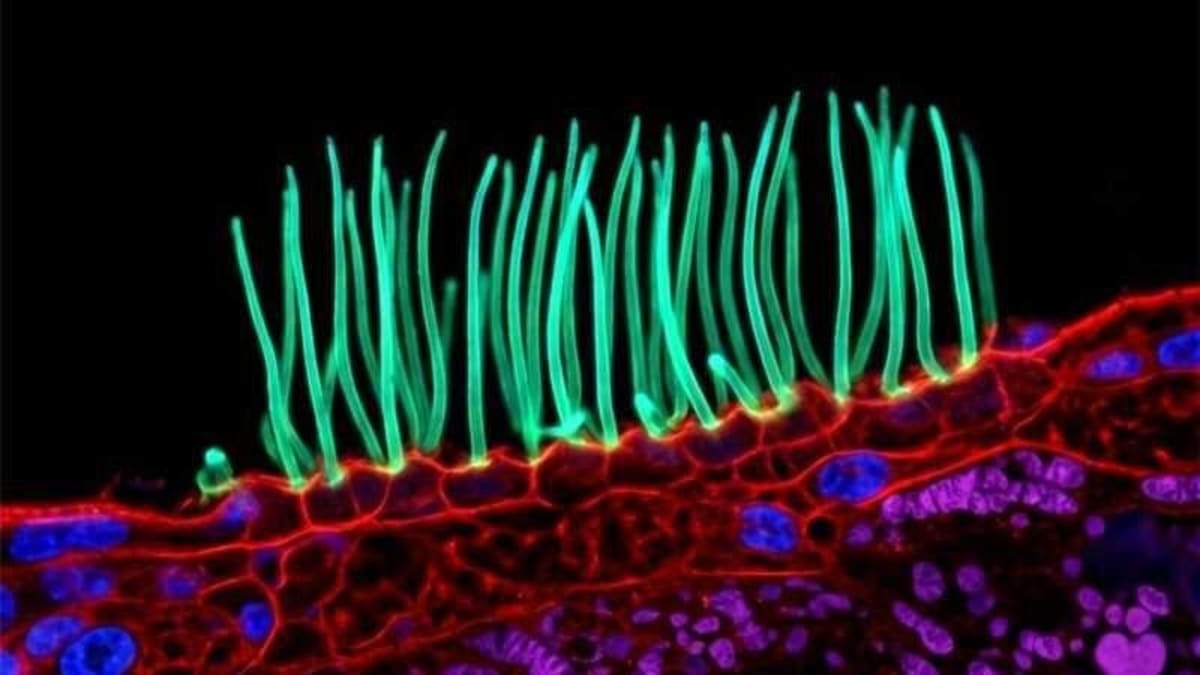
Nikon's Small World in Motion contest has run for 15 years, accepting photos and videos captured through powerful microscopes. The competition's latest winner, a short video by Dr. Ning Xu of Tsinghua University, claims to show cilia moving inside the airways of a child with a rare disease. Now that entry is being re-evaluated after other scientists alleged it was made with AI, according to the BBC.
Xu did not respond to the BBC's request for comment, but he posted online denying he broke the competition rules. In a response to a Nikon post on LinkedIn, he acknowledged using AI in image processing but said he remained within the rules. "AI was not used to generate the experimental movie, the cilia, or their motion," he wrote.
The video is artificially brightly coloured, a common practice in microscopy that is permitted in the contest and usually done manually with stains and dyes. Xu said AI was used "to distinguish and visualize features in the reconstructed grayscale images." Critics argue the video contains shapes and movements that do not match normal cell structures, and that the cilia appear too large.
Edward Phelps, an associate professor at Florida University, commented on Nikon's social media post that some structures "pop in and out of existence" and the cilia "appear from nowhere." Ian Donovan, a PhD student at UT Southwestern Medical Centre, said the source image contained a distinctive watermark indicating it had been AI generated. Two former competition judges also said they had concerns about whether the image was real.
Nikon said Xu was "respectfully complying" with its investigation and had provided additional technical documents. In a statement, the company said: "At this time, we don't see that any rules were violated." It added that an update would come soon.
Dr. Patrick Hickey, who placed fifth in the 2026 Small World contest, said the recognition matters more than the $3,000 prize. "There's a specific set of rules in the contest, and one of them was quite clearly that you couldn't use generative AI to produce things, and the other was obviously that it has to be taken under a microscope," he told the BBC.
The Scientist reported additional details from Nikon Instruments. A spokesperson said organizers had reviewed supporting materials from Xu and confirmed that an AI-assisted enhancement tool was used in post-processing. Nikon determined this use, as a tool for enhancement of microscopy-generated source data rather than image generation from scratch, complied with the competition rules.
Xu explained that he used a custom optical microscope and a technique called diffractive super-resolution microscopy to capture greyscale data, then applied an unsupervised neural network for post-processing and visualization. "It helped us bring out features in the grayscale data and make the final video more visually engaging," he told The Scientist.
Other researchers remain unconvinced. Christophe Leterrier, a neuroscientist at the French National Centre for Scientific Research-Aix Marseille University and a former Nikon Small World jury member, said the processing altered the original image too much. "You have something very nice and very engaging visually but then it's absolutely not representing a biological reality," he said.
Robert Hirst, a lead scientist at Leicester University who uses microscopy to diagnose the disease shown in the video, said the film misleads viewers into thinking there is one cilium per cell when there are about 200. "It's created this substratum underneath the cilia which is wrong in scale, wrong in biology, and just looks completely fabricated," he said.
Hirst also worried that patients with primary ciliary dyskinesia might see the video and think their own cilia look like that. "What worries me most of all is that PCD patients will see this video and think, 'My cilia look like this, and my cells look like this,' and they just don't, unfortunately," he said.
Xu said he understood researchers' concerns. "AI is developing very fast and people want to know what is real and what has been changed by AI," he told The Scientist. He maintained there is an important difference between using AI to create something never present in the experiment and using AI to process or visualize real experimental data.
 artificial intelligence
 Nikon
Nikon Photography
 Science
 Tsinghua University
About this story +
Research and drafting assisted by iFANN Intelligence
- Nikon's Small World in Motion contest has run for 15 years, accepting photos and videos captured through powerful microscopes.confirmed
- The competition's latest winner, a short video by Dr. Ning Xu of Tsinghua University, claims to show cilia moving inside the airways of a child with a rare disease.confirmed
- Now that entry is being re-evaluated after other scientists alleged it was made with AI, according to the BBC.confirmed
- Xu did not respond to the BBC's request for comment, but he posted online denying he broke the competition rules.confirmed
- In a response to a Nikon post on LinkedIn, he acknowledged using AI in image processing but said he remained within the rules.confirmed
- "AI was not used to generate the experimental movie, the cilia, or their motion," he wrote.confirmed
- The video is artificially brightly coloured, a common practice in microscopy that is permitted in the contest and usually done manually with stains and dyes.confirmed
- Xu said AI was used "to distinguish and visualize features in the reconstructed grayscale images."confirmed
- Critics argue the video contains shapes and movements that do not match normal cell structures, and that the cilia appear too large.confirmed
- Edward Phelps, an associate professor at Florida University, commented on Nikon's social media post that some structures "pop in and out of existence" and the cilia "appear from nowhere."confirmed
- Ian Donovan, a PhD student at UT Southwestern Medical Centre, said the source image contained a distinctive watermark indicating it had been AI generated.confirmed
- Two former competition judges also said they had concerns about whether the image was real.confirmed
- Nikon said Xu was "respectfully complying" with its investigation and had provided additional technical documents.confirmed
- In a statement, the company said: "At this time, we don't see that any rules were violated."confirmed
- It added that an update would come soon.confirmed
- Dr. Patrick Hickey, who placed fifth in the 2026 Small World contest, said the recognition matters more than the $3,000 prize.confirmed
- "There's a specific set of rules in the contest, and one of them was quite clearly that you couldn't use generative AI to produce things, and the other was obviously that it has to be taken under a microscope," he told the BBC.confirmed
- The Scientist reported additional details from Nikon Instruments.confirmed
- A spokesperson said organizers had reviewed supporting materials from Xu and confirmed that an AI-assisted enhancement tool was used in post-processing.confirmed
- Nikon determined this use, as a tool for enhancement of microscopy-generated source data rather than image generation from scratch, complied with the competition rules.confirmed
- Xu explained that he used a custom optical microscope and a technique called diffractive super-resolution microscopy to capture greyscale data, then applied an unsupervised neural network for post-processing and visualization.confirmed
- "It helped us bring out features in the grayscale data and make the final video more visually engaging," he told The Scientist.confirmed
- Christophe Leterrier, a neuroscientist at the French National Centre for Scientific Research-Aix Marseille University and a former Nikon Small World jury member, said the processing altered the original image too much.confirmed
- "You have something very nice and very engaging visually but then it's absolutely not representing a biological reality," he said.confirmed
- Robert Hirst, a lead scientist at Leicester University who uses microscopy to diagnose the disease shown in the video, said the film misleads viewers into thinking there is one cilium per cell when there are about 200.confirmed
- "It's created this substratum underneath the cilia which is wrong in scale, wrong in biology, and just looks completely fabricated," he said.confirmed
- Hirst also worried that patients with primary ciliary dyskinesia might see the video and think their own cilia look like that.confirmed
- "What worries me most of all is that PCD patients will see this video and think, 'My cilia look like this, and my cells look like this,' and they just don't, unfortunately," he said.confirmed
- Xu said he understood researchers' concerns.confirmed
- "AI is developing very fast and people want to know what is real and what has been changed by AI," he told The Scientist.confirmed
- He maintained there is an important difference between using AI to create something never present in the experiment and using AI to process or visualize real experimental data.confirmed